
Areola Tattooing: The Honest Deep Dive Nobody Publishes | Kandor Co.
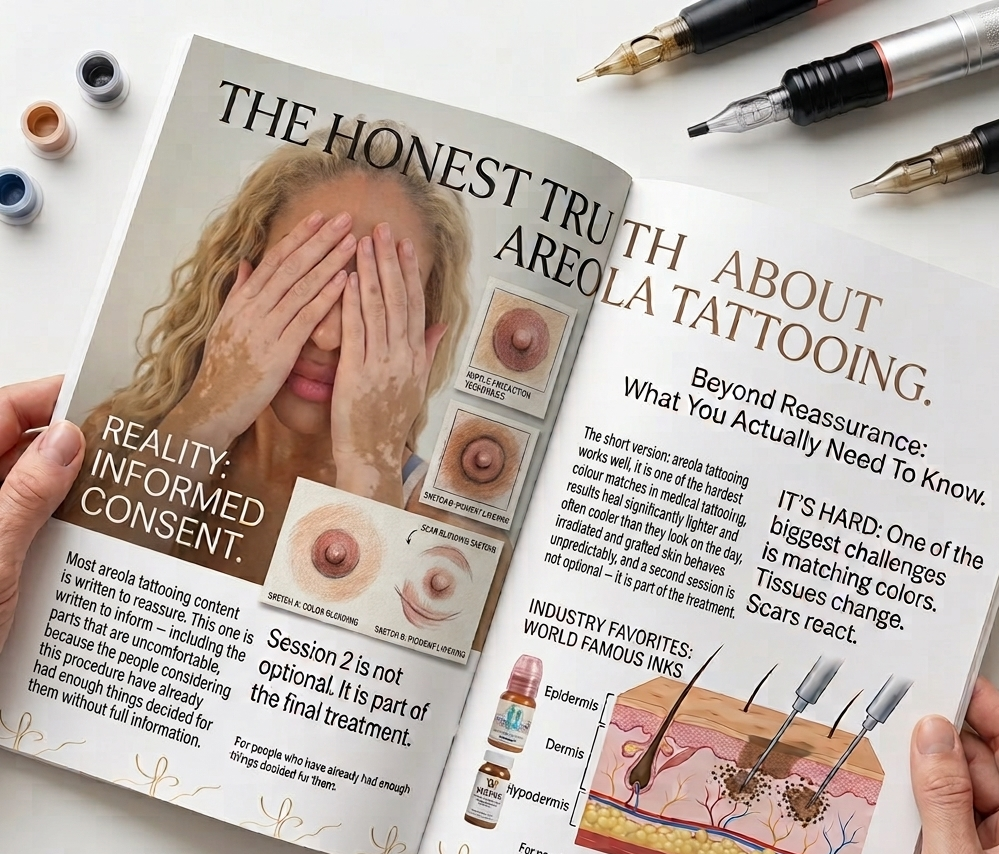
Most areola tattooing content is written to reassure. This one is written to inform, including the parts that are uncomfortable, because the people considering this procedure have already had enough things decided for them without full information.
The short version: areola tattooing works well, it is one of the hardest colour matches in medical tattooing, results heal significantly lighter and often cooler than they look on the day, irradiated and grafted skin behaves unpredictably, and a second session is not optional it is part of the treatment.
Why areola colour is genuinely difficult
Areola tissue is not one colour. It is a gradient usually deeper at the nipple, softening outward, with variation in undertone across the same small area. It is also more pigmented than the surrounding breast skin, meaning you are creating contrast rather than concealing it.
Then there is what happens after implantation.
Pigment heals lighter. Substantially. Fresh work looks intense and saturated; healed work is typically 30–50% softer. A practitioner matching for the day of appearance will produce an under saturated healed result.
Pigment heals cooler. Warm tones drop out faster than cool ones during healing. A mix that looks correctly warm on the day frequently heals grey, ashy or mauve. This is the single most common areola tattooing failure and it is a colour theory failure, not a technique failure.
It heals differently on different skin. On deeper skin tones, the cooling effect is more visible and more damaging to the result, because an ashy heal contrasts sharply against warm undertoned surrounding skin. This is why deeper skin tones are disproportionately represented among disappointing areola results — not because the procedure does not work, but because pigment selection is routinely taught around a narrow range of skin.
The fix is mixing rather than selecting, building the colour with warm correction deliberately over weighted to survive the healing shift. This is the core of the Kandor Camouflage Method and it is precisely why the Method exists.
Why results heal grey — and what should have happened instead
If an areola tattoo has healed grey, ashy or mauve, one of four things usually happened:
The pigment was too cool to begin with
Insufficient warm correction
The pigment was implanted too deep
A pre matched pigment was used
Can it be corrected? Usually, yes. Grey healing is generally correctable by overlaying warm corrected pigment at the appropriate depth, though it takes more sessions than getting it right first time and the result may be slightly less refined. A practitioner experienced in correction work is a different skill set from one doing original work — ask specifically.
Irradiated skin: the honest version
Radiotherapy changes skin permanently. Irradiated tissue is frequently thinner, less vascular, more fragile, and slower to heal. It also holds pigment less reliably and less evenly.
What this means practically:
Expect reduced retention — sometimes considerably
Expect at least one additional session, sometimes two
Expect patchier initial results that even out across sessions
A cautious practitioner will work lighter and build, rather than saturating
Some areas may never hold colour as densely as non-irradiated skin
None of this means you cannot have the treatment. It means your practitioner should assess the tissue properly, tell you this in consultation and price accordingly. A practitioner who does not mention radiotherapy effects at all has either not encountered them or is not telling you.
Grafted and flap reconstruction tissue
Reconstruction using tissue moved from elsewhere on the body (abdomen, back, thigh) brings skin with a different original colour, thickness and blood supply to the chest.
This affects everything. The base colour you are working over, how the pigment reads once healed and how the tissue accepts implantation. Donor skin from the abdomen is frequently lighter and differently toned than chest skin, so the practitioner is correcting for the underlying canvas as well as building the areola.
It is very achievable. It requires someone who understands they are painting on a different surface than they are used to.
Realistic limits — the things that are true
Symmetry is approximate. Natural bodies are not symmetrical. Reconstructed bodies less so. A skilled practitioner gets close; nobody gets identical.
The 3D effect is optical. It is convincing in a mirror and in most light. It is less convincing under direct overhead light at close range, because there is no actual raised tissue casting shadow. This is a physical fact, not a skill limitation.
There is no sensation restoration. Tattooing does not restore nerve function.
Colour fades. Three to five years typically, less on irradiated skin, less with sun exposure.
One session is not enough. Anyone offering a singles ession complete result is either inexperienced or overselling. Two or three is standard. Irradiated or grafted tissue often needs three sometimes four.
What good practice actually looks like
Position marked with you sitting upright, in a mirror, before any needle touches you
Colour mixed in front of you and tested, not selected from a chart
Warm correction explained, not just applied
Explicit discussion of how it will heal, including the panic stages
Written consent covering photography with a genuine option to decline
Your surgical or oncology team's agreement confirmed
A follow up session booked before you leave
Healed photographs available to view, at six to twelve weeks
If four or more of those are missing, keep looking.
WE ARE LOOKING FOR AREOLA TATTOO MODELS — Bedford & Nottingham
Kandor Co. is seeking models for areola restoration during our practitioner training days in Bedford and Leicester.
What this means for you:
The procedure is performed at a heavily reduced rate and sometimes no cost at all.
It is carried out by Keira and a trainee under her direct supervision at every stage
Full consultation, full consent process, full aftercare and aftercare product included
Follow up session included
Who we are looking for:
Post mastectomy, or breast surgery leaving you with no areola tissue or skin, with or without reconstruction
Flat closure clients very welcome
All skin tones
Existing areola tattoos that have healed poorly, for correction work
Fully healed, at least three to six months post final surgery, with your medical team's agreement
What we need from you:
Honesty about your surgical and treatment history
Availability for an online consultation beforehand and a follow up afterwards
Willingness to be in a room with a small number of people 1-3 — always with your explicit consent, and always with the option to say no
What we will never do: Rush you, pressure you, photograph you without written consent, use your images in a way you have not agreed to.
Click here to send us a message to be a model!
Applications are reviewed personally. You will speak to a human before anything is decided.
Why we use real models, and why we are open about it
Practice skins do not bleed, blanch, flush or heal. Irradiated tissue does all four in ways latex cannot simulate. A practitioner who has only worked on synthetic skin has never seen pigment lift unpredictably from grafted tissue, and will meet that for the first time on a paying client.
We are open about model recruitment because the alternative — practitioners quietly learning on clients who believe they are receiving standard treatment — is worse for everyone. If you model for us, you know exactly what is happening, you are supervised at every stage, and you are treated as a person doing us a favour, because you are.
Frequently asked questions
Why does my areola tattoo look grey?
Usually because the pigment was too cool or insufficiently warm corrected for how it would heal, or implanted too deep. It is generally correctable with warm-corrected overlay work by an experienced practitioner.
Can a bad areola tattoo be fixed?
In most cases, yes. Colour correction and reshaping are both possible. It takes more sessions than an original treatment. Look specifically for a practitioner who does correction work.
Why do I need two sessions of areola tatooing?
Pigment heals significantly lighter and retention is uneven, particularly on scar, grafted or irradiated tissue. The second session adjusts colour and depth once the true healed result is visible.
Is areola tattooing different on darker skin?
The procedure is the same; the colour work is harder and more frequently done badly. Warm correction matters more, because ashy healing contrasts far more visibly against warm-undertoned skin. Ask any practitioner directly how they mix for deeper skin tones.
How long after radiotherapy can I have areola tattooing? Generally at least six months, with your oncology team's agreement. Expect reduced retention and extra sessions.
Can I model if I have had a bad areola tattoo result elsewhere?
Yes — correction cases are genuinely valuable for training and we would welcome your application.
If you want to train in this: Kandor Co. teaches areola restoration as part of the Kandor Camouflage Method. ENQUIRE ABOUT TRAINING HERE.
Keira Walcott is the founder of Kandor Co. and developer of the Kandor Camouflage Method. She has lived with vitiligo since the age of fourteen. Kandor Co. is based in Bedford and trains paramedical camouflage practitioners across the UK and internationally.