
Claim Your Space Now
Claim Your Space Now
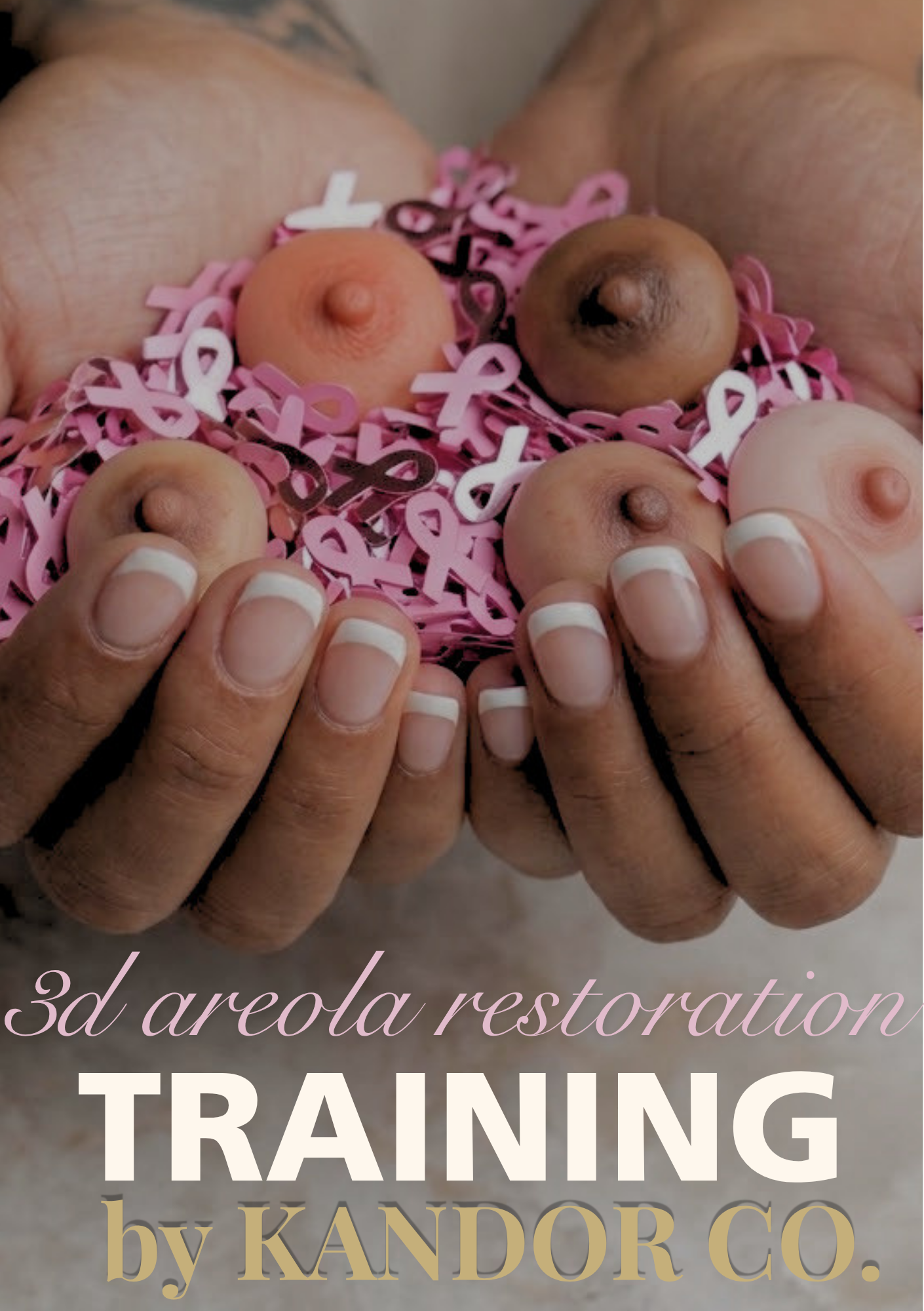
Most areola training teaches you to tattoo. Almost none teaches you the client.
You can learn 3D shading from a video. What you cannot learn from a video is which chest to refuse, how long to wait after radiotherapy, why your pigment healed grey at six months, what you are legally required to record, or how to run a consultation with a woman who has not looked at her own chest in two years.
This course covers all of it. The tattooing is five modules. The other ten are the reason your work holds up, your clients trust you, and your insurer stays happy.
The modules, start to finish
Work through it at your own pace, in order. Every module ends with an assessment.
Who your client is: the UK picture
Who actually books areola restoration in Britain, which route they arrived by, and why each route leaves you a different chest to work on.
Breast cancer: types, treatments, and what they mean for your work
The cancer type does not change how you tattoo. The treatment does. Every type, every treatment, and exactly what each one leaves in the tissue.
Surgery types: what each one leaves behind
Mastectomy, DIEP and other flap reconstructions, implant reconstruction, flat closure and top surgery. What each produces, and how it changes your plan.
Scar types and how they behave
Atrophic, hypertrophic, keloid and adherent scarring. How to type a scar by hand, test maturity, and predict how it will take pigment.
When they're ready, and when they're not
Every timing gate, the medical clearances you need in writing, and the absolute and relative contraindications. Knowing who not to treat protects you more than any technique ever will.
The sensitive consultation: trauma-informed practice
How to run the conversation, the room and the undressing without causing harm. What to say, what never to say, and how to handle crying, disclosure and unrealistic expectations.
Consent, privacy, dignity and UK GDPR
The Montgomery standard for informed consent. What you must record, how clinical photographs are handled lawfully, and why separate photography consents are not optional.
Infection control, cleaning and clinical setup
Why the bar is higher here than anywhere else in permanent makeup, and the full station protocol: barrier film, clean-to-dirty flow, sharps, waste and spillage.
Colour: why most areola work heals wrong
Pigment heals lighter and cooler, and warm tones drop out first. Reading depth and undertone separately, mixing for the healed result, and why deeper skin tones are failed by the pigment range rather than by the skin.
Design, placement and the 3D illusion
Marking upright, mirrored light direction, and the four marks that make a flat chest read as a nipple standing on it. Highlight, core shadow, contact shadow and cast shadow.
Technique
Stroke length, machine calibration, needle choice, three-point stretch, depth, passes and dilution. How to work tissue that will not behave like skin, and when to stop.
Healing and aftercare
What you tell her, what you send her home with, and what healed actually looks like at week six rather than at day one.
The healed case library
Real cases start to finish, including the ones that went wrong, so you can see the pigment shift over months rather than take anyone's word for it.
UK legal, insurance and registration
Local authority registration, insurance that genuinely covers paramedical tattooing, and the paperwork you need in place before your first client.
Pricing and building an areola practice
What to charge, how to structure a package, and the breast care nurse referral network, which is worth more than a year of social media.
BONUS
Free for all students
Bring your own model future date
You are welcome after the training both in person and online to bring your own model and work on them with Keira in the room.
Your model, your case, your pace
Supervised start to finish
Colour matched together before you start
Counts towards your certification case
Open to every student, online or classroom
No charge - one time offer per student
Why the model day is free
Most areola courses put you on a shared live model for one rushed afternoon and call it certification. You get perhaps forty minutes on a stranger's chest, under pressure, with four people watching.
That is not how you learn this, and it is not how she should be treated either.
So the model day is separate, unhurried, and costs nothing. You bring someone you have already consulted with. We match colour together, you work, and we are beside you the whole time.
Who it's for
Qualified SPMU artists adding areola restoration or people ‘bolting on’ this course with another masterclass.
Tattooists moving into paramedical work
Paramedical practitioners already doing scar camouflage
Anyone certified in the Kandor Protocol
Who it isn't for
Complete beginners without creative skill or a confident mindset.
Anyone looking for a one day certificate with no assessment
Anyone who wants to skip the clinical modules
This is medical tattooing on people who have been through cancer treatment. The clinical modules are the course, not the preamble.