
Top Surgery Scar Camouflage & Areola Tattooing: A UK Guide | Kandor Co.
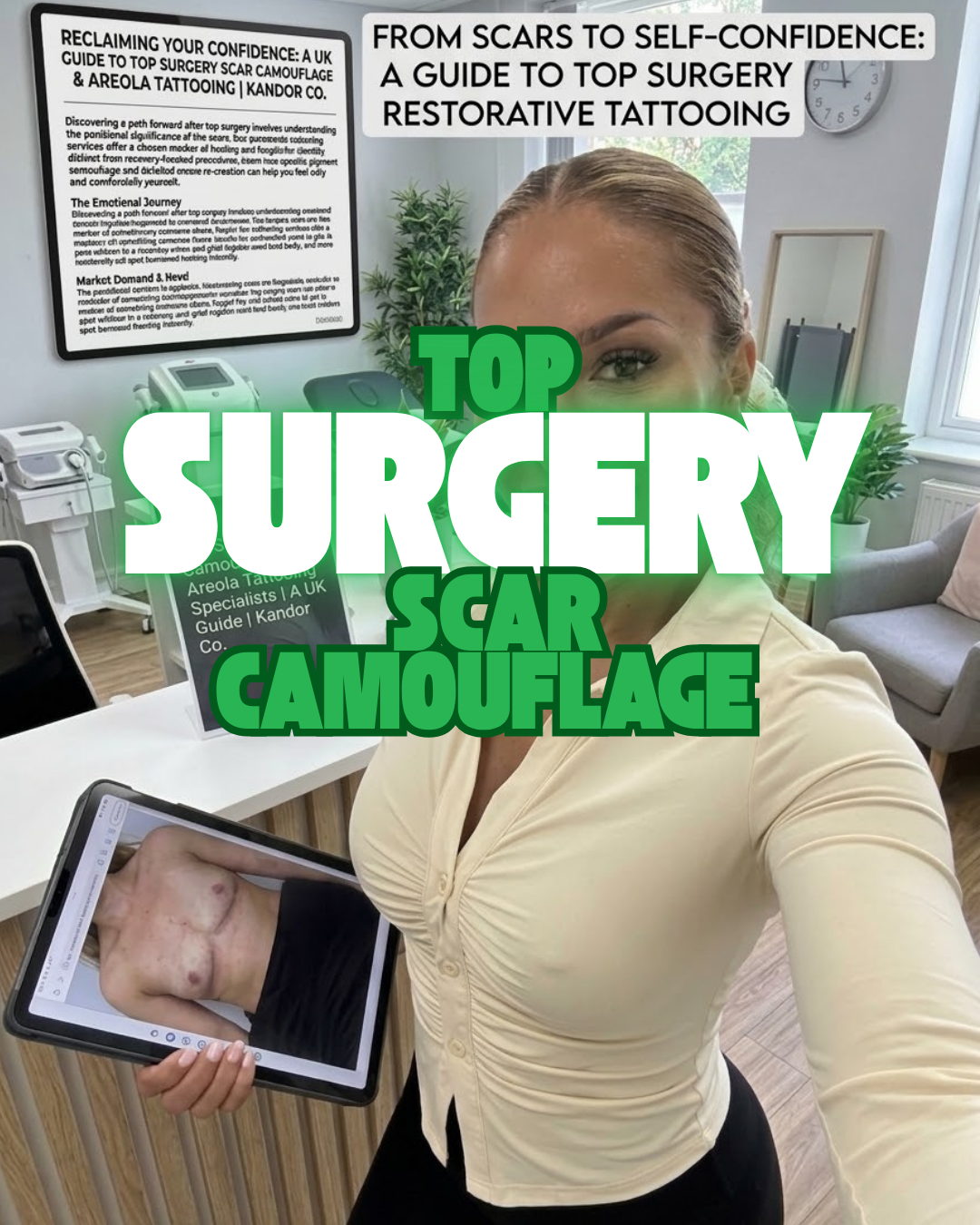
Top Surgery Scar Camouflage and Areola Tattooing
After top surgery, two paramedical tattooing options are available: scar camouflage, which reduces the colour contrast between the chest scars and surrounding skin, and areola tattooing, which recreates or refines nipple and areola appearance using pigment, shading and highlight.
Most people are ready 6-12 months after surgery, once scars have fully matured. Areola work is sometimes possible earlier depending on healing.
Both are semi permanent, typically need two to three sessions and neither changes the scar itself — they change how visible it is.
What scar camouflage does for top surgery scars
Double incision scars run horizontally across the chest and typically settle either lighter (hypopigmented) or darker and pinker (hyperpigmented) than surrounding skin. Periareolar and keyhole techniques leave less extensive scarring but can still leave visible colour contrast.
Camouflage works on the colour, not the texture. Medical needling targets texture and is used first if needed. Pigment is implanted to reduce the contrast so the scar line reads closer to surrounding skin rather than as a distinct band.
Areola tattooing after top surgery
Three situations come up most:
Nipple grafts that healed pale or uneven. Free nipple grafts frequently lose pigment during healing, sometimes substantially. Tattooing restores colour and definition, and can even out patchy retention. This is the most common request.
No nipple reconstruction. 3D areola tattooing creates the appearance of nipple and areola on a flat chest using shading and highlight. There's no raised tissue — the effect is optical, the way a painter makes a sphere look round on flat canvas. It's convincing in a mirror and in normal light.
Refining size, shape or position. Some people want a smaller areola diameter, a different shape, or better symmetry than surgery achieved. This is straightforward work and entirely reasonable to ask for.
When can I have it?
Scar camouflage: generally 6 to 12 months post-op. The scar needs to be fully matured — no longer pink or actively changing, softened, flat or stable. Treating an immature scar risks a poor result and further scarring.
Areola tattooing: often from 3-6 months, once grafts have fully healed and any swelling has resolved.
You're usually ready when:
All incisions are fully closed and healed
Scars have stopped changing colour month to month
Grafts, if you had them, are fully settled
Your surgeon is happy for you to proceed
No further chest surgery is planned
If revision surgery is a possibility, wait. Tattooing before revision means paying twice and potentially complicating the surgical field. Ask your surgeon directly.
On testosterone?: HRT is not a contraindication for paramedical tattooing. It can affect skin thickness, oil production and healing over time, which is relevant to how a practitioner assesses your tissue so mention it at consultation. Chest hair regrowth over a scar can also affect pigment placement and is worth discussing.
What happens at the appointment
Consultation first. Tissue assessment before any colour discussion — scar maturity, whether it's raised or flat, retention likelihood. For areola work, you'll decide size, shape and position, marked while you're sitting upright, because that's how you'll see yourself.
Colour matched to you. This is where practitioner skill separates. Areola colour is one of the hardest matches in medical tattooing, and pigment heals significantly lighter and cooler than it goes in. Warm tones drop out faster than cool ones, which is why so much areola work heals grey or ashy — and why it happens disproportionately on deeper skin tones, where an ashy result contrasts sharply against warm undertones.
Colour should be mixed in front of you, not selected from a chart.
The tattooing. Around 90 minutes for areola work; scar camouflage varies with scar length. Topical anaesthetic can be used. Many people have reduced sensation across surgical scars and feel pressure rather than pain.
Second session, 4–6 weeks later. Standard, not a sign anything went wrong. Scar tissue holds pigment unevenly and you can't know how much retained until it's fully healed.
Aftercare
Keep the area clean and dry
Apply the aftercare product as directed
No swimming, saunas, hot tubs or heavy sweating for two weeks
No gym sessions that soak the chest for two weeks — plan around it
Don't pick or scratch; flaking is normal
Avoid direct sun; high SPF once healed
Loose clothing, nothing that rubs
Surface healing takes around two weeks, full healing six to eight. Don't judge the result before six weeks. Almost everyone thinks it's too dark around day five and too light around day ten. Both are normal.
What it costs in the UK
Areola tattooing, both sides: £400–£800
Areola tattooing, single side: £250–£500
Top surgery scar camouflage: £250–£600 depending on scar length and sessions
Combined scar plus areola: usually quoted as a package
Refresh session: £100–£250
Ask specifically whether the follow-up session is included. A cheaper headline price with a chargeable second session often costs more overall.
On the NHS: areola tattooing is available in some areas as part of reconstruction pathways, though provision for top surgery specifically varies considerably by trust and is less consistent than for breast cancer reconstruction. Worth asking your surgical team — but expect to go private in most cases.
Choosing a practitioner
Ask to see healed work on top surgery specifically. Not mastectomy work, not brow tattooing. Chest scars and grafted nipples behave differently from anything else.
Ask about their experience with your skin tone. Ashy healing on deeper skin is a real and common failure. A good practitioner will raise it before you do.
Ask about graft tissue. Free nipple grafts hold pigment unpredictably. Someone who hasn't worked on grafts before will be learning on you.
Check they ask about your surgeon and any planned revisions. A practitioner who doesn't ask isn't being careful.
Check they're registered and insured. Local authority registration for tattooing, current professional indemnity.
Check how the consultation feels. You'll be undressed with this person. You should not have to explain or justify your surgery, correct anyone's language, or educate them. If you feel like the first trans client they've thought about, that's information — and there will be other practitioners.
Reasonable questions to ask outright: Have you worked with trans clients before? How many top surgery cases? Can I see healed photographs?
Realistic expectations
What good work does: substantially reduces scar visibility; restores colour to pale or patchy grafts; creates convincing areola appearance where there's none; improves symmetry.
Most people describe the result as the last item on a long list — the point where the chest stops being a project. That's a real and worthwhile thing, and it's also not the same as erasing the surgery.
Frequently asked questions
Can you tattoo over top surgery scars? Yes, once fully matured — generally 6 months onwards.
My nipple grafts healed really pale. Can that be fixed? Yes, and it's one of the most common requests. Tattooing restores colour and can even out patchy retention.
Can I get a 3D areola tattoo with no nipple reconstruction? Yes. The effect is created with shading and highlight and is convincing in a mirror and in normal light.
Does testosterone affect it? HRT isn't a contraindication. It can affect skin thickness, oil production and healing, so mention it at consultation.
Will chest hair be a problem? Regrowth over a scar can affect pigment placement. Raise it at consultation — it's manageable, but it changes the plan.
Does it hurt? Most people report pressure rather than pain, particularly where surgery reduced sensation. Topical anaesthetic is used if needed.
How long does it last? One to three years for scar camouflage, three to five for areola work, before a refresh.
Can I have it before revision surgery? Better to wait. Ask your surgeon — tattooing first can mean paying twice.
Do I have to explain being trans? No. A competent practitioner needs your surgical and medical history, the same as for any client. Nothing else is required.
Will you photograph me? Only with written consent, and you can decline entirely and still be treated. It is best to track your progess though!
Top surgery work at Kandor Co.
Kandor Co. offers scar camouflage and areola tattooing after top surgery, using the colour-mixing approach of the Kandor Protocol which matters here specifically because grafted and scarred chest tissue holds pigment unpredictably, and because pre-matched pigments routinely heal ashy on deeper skin tones.
Consultations are unhurried and clinical. You'll be told honestly if you're not ready. You won't be asked anything beyond the surgical and medical history any practitioner needs.
(top surgery scar tattoo, areola tattoo after top surgery, FTM areola tattooing UK, trans medical tattooing UK, nipple tattoo top surgery)